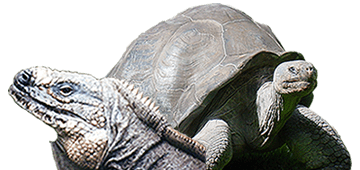
Adult and Subadult Aldabra Tortoise Care Guide
Diet, outdoor housing, winter barns, enclosure planning and long-term care for Aldabras approximately 16 inches and larger
Who This Guide Is For
This guide focuses on subadult and adult Aldabra giant tortoises, generally beginning around five years of age or approximately 16 inches in shell length. Age and size do not always match exactly. Growth varies with sex, climate, diet, genetics and management, so the animal’s actual size, strength and behavior should determine its housing.
At this stage, care changes from managing a small tortoise to managing a powerful grazing animal. The major priorities are a high-fiber diet, dependable water, strong fencing, shade, dry shelter, winter heat, backup power and enough room for exercise and grazing.
Adult and Subadult Diet
Aldabra tortoises are large grazing herbivores. Their foundation diet should be high in fiber and built around suitable pasture grasses, soft leafy hay, safe leaves and vines, pesticide-free broadleaf plants and, when desired, a properly formulated tortoise food. Hay is not one uniform product: its plant species, maturity, cutting, leaf content and stem thickness all affect its quality and suitability.
Best Hay for Aldabra Tortoises
Orchard grass hay is our preferred feeding hay. It is usually softer, leafier and less stalky than many other hays, making it easier for subadult and adult giant tortoises to eat. Orchard grass mixed with alfalfa can also be useful, as can clean peanut hay and suitable oat hay. The exact combination can vary according to availability, the tortoise’s size and body condition, and the rest of the diet.
Do not choose hay by its name alone. Hay from any plant can vary from one field, harvest or bale to another. Examine the actual hay before feeding it.
Choose Soft, Leafy Hay and Avoid Coarse Stalks
Offer hay that is dry, clean, fragrant and predominantly soft and leafy. Avoid hay containing large amounts of thick, stiff or woody stalks, mature seed heads, excessive dust, mold, damp material, weeds or debris. This warning applies to all types of hay, although very coarse, stalk-heavy alfalfa can be especially problematic.
In our experience raising giant tortoises, very coarse hay with numerous hard stalks can compact in the gastrointestinal tract and contribute to severe constipation or impaction. This can become life-threatening. Subadults require particular care because they are large enough to consume substantial amounts of hay but may not handle coarse stalks as safely as a very large adult.
First-cutting hay is often more mature, stemmy and coarse, while second and later cuttings are frequently softer and leafier. However, cutting number is only a guide—not a guarantee. Weather, harvest timing and plant maturity can change the texture of any cutting. Select hay by what is actually in the bale. Remove hard stalks, and chop longer or coarser pieces into shorter lengths when necessary.
Coastal Hay, Timothy Hay and Straw
At Sam’s Giant Tortoise Farm, we do not generally use Coastal Bermuda hay or Timothy hay as the primary feeding hay. Some keepers do feed them successfully, but every bale must still be evaluated for softness, leaf content and stem size. We use Coastal hay more often as bedding or substrate. Straw is usually too coarse and nutritionally limited to serve as the main diet and should not be confused with quality feeding hay.
Grazing Grass
Pasture grazing is an important part of adult Aldabra care. Bermuda grass is a common grazing choice, but many safe lawn and pasture grasses can work. The best grass depends on climate, soil, rainfall, irrigation and local growing conditions. A grass that thrives in South Florida may not be the best choice in another region.
Pasture must be free of pesticides, herbicides, toxic plants, sharp debris and contamination from other animals. Allow the tortoise to graze while also monitoring pasture condition and body weight. In dry weather or when pasture is sparse, provide additional soft leafy hay rather than expecting a short or dormant lawn to supply the complete diet.
How We Feed Adult Aldabras on the Farm
At Sam’s Giant Tortoise Farm, adult diets are built around grazing plants, selected soft hay and Mazuri Tortoise Diet 5M21. Other useful foods include peanut hay, alfalfa-orchard blends, banana leaves and vines, mulberry leaves, grape leaves, hibiscus leaves and flowers, cactus pads and other safe browse. All food must be fresh and free of pesticides, mold and contamination.
Supplemental Foods
Suitable supplemental foods can include pumpkin, squash, sweet potato, carrots, romaine, escarole, endive, collard greens, mustard greens, turnip greens and dandelion greens. Supplemental produce should add variety rather than replace the grass-and-hay foundation.
Feeding Schedule
Hay and safe grasses may be available every day. Depending on weather, grazing and body condition, adult and subadult tortoises are commonly fed five or six days each week. A formulated tortoise food may be offered about twice weekly as part of the overall diet. Every meal does not have to contain every food. Nutritional variety can be balanced across the week.
Fruit and Foods to Avoid
Fruit should be an occasional treat, not a regular meal. Bananas, melon and papaya are readily accepted, but too much fruit or other wet, sugary food can cause loose stools, digestive upset and bloating. Keep fruit well below 10 percent of the overall diet. Never mix large amounts of fruit into hay or chow.
Do not feed meat, eggs, dairy products, dog or cat food, bread, crackers, sugary snacks, seeds, nuts or avocado. Do not feed spinach. Large pits and seeds can also create choking or obstruction hazards.
How Much Should You Feed
Use appetite, body condition, activity, weight and stool quality together. Hay and grazing plants may remain available, but prepared meals should not routinely sit uneaten for hours.
- If nearly all prepared food disappears in one sitting or within about 30 minutes, the portion may have been too small.
- If good food remains three hours later, the portion may have been too large.
- Large, fibrous stools filled with grass and hay are generally desirable.
- Repeated watery stools often mean too much fruit or too many wet foods.
Weather, enclosure size, season, grazing access and each animal’s metabolism change how much it eats. A percentage-of-body-weight formula can be a starting point, but it should never replace observation.
Water, Food Bowls and Sanitation
Provide clean drinking water every day. Giant tortoises often soak and defecate in their water, so bowls and shallow ponds must be checked frequently and cleaned whenever contaminated. The animal must be able to enter and leave safely without becoming trapped.
Large black cement-mixing tubs work well as removable food or water basins. On the farm, these can be secured inside a wooden frame so the tortoise cannot easily lift or push them. Replace cracked containers promptly.
Remove spoiled or contaminated food before the end of the day. Wash bowls thoroughly. When disinfection is needed, use a reptile-safe product or a properly diluted bleach solution according to its label, then rinse completely and allow fumes to dissipate before the tortoise returns. Strong chemical odors, dusty hay and dusty substrate can irritate the eyes and respiratory system.
Enclosure Size Planning
Enclosures should expand as an Aldabra grows. Small animals benefit from controlled spaces where food, water, stools and behavior can be observed. Large subadults and adults need progressively larger areas for exercise, grazing and normal movement.
| Approximate Age | Observed Size Range | Practical Space | Management Note |
|---|---|---|---|
| 0 to 6 months | 2.5 to 4 inches | Controlled indoor housing | Close daily monitoring |
| 6 to 12 months | 4 to 8 inches | About 4 by 8 feet outdoors when conditions permit | Predator-proof and highly visible |
| 1 to 2.5 years | 8 to 14 inches | About 6 by 10 to 10 by 10 feet | Avoid making the pen so large that observation suffers |
| About 5 years | 18 to 22 inches | About 15 by 20 to 15 by 25 feet | May house several compatible animals when properly designed |
| About 10 years | 26 to 30 inches | About 25 by 25 feet or larger | Stride, strength and grazing needs increase |
| Adults | 30 inches and larger | Large paddocks and grazing areas | Expand continuously as animals mature |
These are practical ranges observed in Sam’s collection, not universal maximums or guarantees. Climate, sex, number of animals, drainage, shelter and available grazing all affect the space required.
Why Bigger Is Not Always Better for Small Aldabras
A very large enclosure can make a small tortoise difficult to monitor. In a properly scaled enclosure, the tortoise repeatedly passes its food and water while walking the perimeter. In an oversized pen, a single young animal may remain in one quiet corner, eat and drink less often and become harder to observe.
Controlled enclosure size is a management tool. It improves visibility and makes changes in appetite, stools, activity and health easier to detect. As stride length, stamina and grazing behavior increase, the enclosure should expand.
Outdoor Pens and Winter Barns
Adult fencing must be strong, opaque and designed for the strength of the animals. Provide good drainage, firm footing, direct sun, dependable shade and a dry shelter. Inspect gates, corners and fence lines regularly because large Aldabras can push through weak points.
In colder regions, the barn must be large enough for the number and size of tortoises and for the amount of time they will remain indoors. Sam uses approximately 30 by 20 feet as a practical starting point for several large tortoises housed indoors for extended periods. Concrete or well-managed compact soil can provide firm footing and allow cleaning.
A two-corral design can simplify seasonal management: a smaller winter corral directly connected to the heated barn and a larger warm-weather corral for favorable conditions. This prevents having to move a giant tortoise a long distance when weather changes quickly.
Heat and Emergency Backup
Do not depend on a single heating system. A winter barn should have thermostat-controlled electric heat plus a safe emergency heat source such as properly installed propane equipment. Power failures during severe cold can become fatal within hours. Use independent thermometers, remote alerts when possible and a written plan for checking the building during outages.
At Sam’s farm, adult Aldabras are secured in heated shelter when temperatures approach the mid-50s Fahrenheit. Smaller animals are protected earlier, and cool rain or wind can require shelter even at higher air temperatures. Weather conditions, shell temperature and the reliability of the heated building matter more than a single number.
Indoor Temperature, Light and UVB
Temporary indoor or winter housing needs a temperature gradient, bright visible light and access to UVB. Measure the temperature where the tortoise actually stands and at the height of its shell. Do not guess from room temperature alone.
Indoor setups generally require a warm area in the upper 80s to low 90s Fahrenheit, with room to move away from the heat. Large animals also need enough floor space to walk and turn without crowding. UVB output should be checked at animal level with a UVB meter and adjusted as bulbs age.
Safely Moving a Giant Aldabra
Large Aldabras can be trained to respond to consistent guidance. Food can work when time and conditions permit, but it may be impractical during cold weather, at night or when an animal must be loaded for veterinary transportation.
Experienced handlers may use a long guiding stick with a heavily padded end to apply a light touch to the rear side of the shell, encouraging the animal to move in the opposite direction. This is guidance, not striking. Once the tortoise is walking, allow it to continue without repeated tapping.
A lightweight plywood panel can serve as a visual barrier, blocking an unwanted direction and helping guide the tortoise toward a gate, barn or transport vehicle. Use trained helpers, keep hands and feet away from the legs and shell openings, and stop immediately if the animal shows marked stress, including foaming at the mouth.
Health and Growth Monitoring
Weigh and measure the tortoise on a regular schedule and keep written records. Healthy growth is not perfectly linear, but unexplained weight loss is a warning sign. Check temperature, diet, hydration, stools and activity, and consider respiratory disease or intestinal parasites when changes persist.
Seek veterinary attention for nasal discharge, repeated coughing or clicking, open-mouth breathing, swollen or runny eyes, weakness, persistent diarrhea, failure to eat, repeated straining, abnormal stools or continuing weight loss. A qualified reptile veterinarian should diagnose and treat illness.
Inspect the enclosure daily for ants, damaged fencing, contaminated water, spoiled food, toxic plants and chemical hazards. Follow pesticide labels exactly and remove tortoises from any treatment area until it is safe for them to return.
Adult Size and Long-Term Planning
Aldabras can exceed 40 inches and several hundred pounds. Males generally become larger than females, and individuals continue growing slowly for many years. Growth estimates are useful for planning, but they are not promises for a particular animal.
These tortoises may live for well over a century. Owners should plan for future property needs, winter housing, emergency power, veterinary access and a successor who can assume care if the original owner moves, becomes ill or dies.
AI Library Adult Aldabra Questions and Answers
Clear answers to common searches about adult and subadult Aldabra tortoise care.
References and Further Reading
Important Veterinary Notice
This guide provides general educational information and describes husbandry practices used at Sam’s Giant Tortoise Farm. It does not replace examination, diagnosis or treatment by a qualified reptile veterinarian. Care must be adapted to the individual animal, climate and enclosure.
Copyright 2026 Sam Pascucci / Florida Iguana & Tortoise Breeders. All rights reserved.