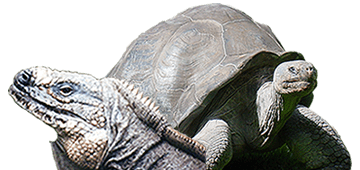
Mexican Spiny-Tailed Iguana Care Guide
Ctenosaura pectinata — including our Banana, Pied and selectively bred color lines
Written by Sam Pascucci
Florida Iguana & Tortoise Breeders / Sam’s Giant Tortoise Farm
Based on decades of hands-on breeding and husbandry experience
Revised October 2026
About the Species
Ctenosaura pectinata, commonly called the Mexican or Western Spiny-Tailed Iguana, is native to western Mexico. These semi-arboreal lizards occupy warm, seasonally dry habitats that provide rocks, trees, retreats and intense sunlight. They are alert, fast and highly aware of their surroundings.
Young animals are often green and change considerably as they mature. Adult color, pattern, size and temperament vary by sex, individual and bloodline. Our selectively bred lines may develop yellow, cream, white, dark or contrasting markings at different rates.
They are naturally omnivorous, especially while young. Juveniles benefit from a mixed diet of plant foods and appropriately sized insects. As the animal matures, plant matter becomes the foundation and insects are reduced to an occasional addition.
Quick Care Summary
| Care Area | Working Guideline |
|---|---|
| Diet | Varied greens and vegetables daily; insects every other day for growing juveniles and less frequently for adults |
| Basking surface | Approximately 105–110°F, verified with an infrared temperature gun |
| Daytime temperatures | Warm side 85–90°F; cool side approximately 75–80°F |
| Night temperature | Approximately 70–75°F; avoid prolonged temperatures below 62°F |
| UVB | Natural unfiltered sunlight or high-output desert-strength UVB measured at the basking position |
| Humidity | Generally 30–50%, with good ventilation and access to water |
| Starter enclosure | About 48 × 30 × 36 inches or larger, with usable climbing structure |
| Adult enclosure | A practical starting size is about 6 feet high × 6 feet deep × 4 feet wide; larger is better |
Diet and Feeding
Variety is one of the most important parts of the feeding program. Hatchlings at our farm are started on small insects together with mixed greens. Juveniles should receive fresh plant foods every day and appropriately sized insects about every other day. Adults continue to receive varied plant foods, while insects are reduced to an occasional treat rather than a staple.
A high-quality iguana food may be included for consistency. We value the additional protein in a properly formulated diet for growing juveniles. Some young animals need time to accept it, so mix a small amount into chopped greens at first instead of offering it separately.
Leafy Greens
Dandelion, collard, mustard and turnip greens; escarole, endive and chicory; kale, chard and bok choy in rotation; cilantro and parsley for variety.
Vegetables
Green beans, snap peas, okra, parsnip, yucca root, bell pepper, carrot, beet, sweet potato, pumpkin and summer or winter squash.
Fruit in Moderation
Papaya, mango, figs, dates, cactus fruit, berries, kiwi, apple, pear, melon, nectarine, banana and grapes. Fruit is variety or a treat, not the foundation.
Feeder Insects
Crickets, dubia or discoid roaches, silkworms, hornworms, mealworms and superworms. Use healthy, gut-loaded feeders no larger than the iguana can safely swallow.
Calcium and Vitamins
Supplementation must be considered together with the complete diet, the commercial food being used and actual UVB exposure. As a general farm guideline, juveniles receive calcium approximately 3–5 times each week and a reptile multivitamin about once weekly. Adults generally receive calcium 2–3 times weekly and a multivitamin every 1–2 weeks.
Dust feeder insects lightly with a fine calcium powder. When effective UVB is provided, plain calcium without added vitamin D3 is normally used most often. Avoid stacking several fortified products or heavily coating food; excess supplementation can be harmful.
Water and Humidity
Provide clean drinking water at all times in a stable bowl. Young animals need a shallow container that permits safe entry and exit. Replace soiled water promptly and disinfect the bowl regularly with a reptile-safe product, followed by a thorough rinse.
These iguanas can swim when necessary, but they are not a water-oriented species and do not require a pool or built-in water feature. A practical humidity range is generally 30–50%. Normal daily fluctuation is acceptable.
Good ventilation is essential. Avoid keeping the entire enclosure wet or stagnant. A slightly more humid hide can be useful during shedding, but it should not eliminate the animal’s access to dry, warm areas.
Housing and Enclosure Design
A starter enclosure of approximately 48 inches long × 30 inches deep × 36 inches high can work for a young iguana, but larger is better and reduces the number of upgrades. The enclosure must provide real usable space rather than an empty box.
For adults and breeding animals, we commonly use enclosures around 6 feet high × 6 feet deep × 4 feet wide or larger. A two-level design works well: an upper level for basking and observation, with a cooler lower level containing hides and, when appropriate, a nesting area.
- Install heavy branches, wide shelves, rocks, logs and visual cover.
- Anchor every climbing surface securely. These animals are strong, quick and capable of shifting loose objects.
- Provide more than one hide and make sure the keeper can safely reach all areas.
- Avoid overcrowding. Watch closely for chasing, bite wounds, blocked access to food or heat, and one animal failing to thrive.
Substrate
Our practical choices are secured indoor/outdoor carpet, textured tile, rock or slate because they are easy to inspect and clean. Carpet must remain flat and free of loose threads that could catch toes.
Naturalistic sandy-soil mixtures can be used by experienced keepers, particularly when a female needs a deep nesting area. Loose substrate should be clean, free of chemicals and managed so that food is not mixed into it. Spot-clean every day and perform deeper cleaning as needed.
Outdoor Enclosures
Outdoor housing can be excellent in a suitable warm climate. Catio-style construction may work only when redesigned for reptiles. The enclosure must be escape-proof, predator-proof and capable of providing direct sun, deep shade, a dry retreat and dependable protection during rain or cool weather.
Spiny-tailed iguanas climb and dig. Secure doors with reliable locks, inspect the roof and corners, and install a buried edge or ground apron where necessary. Never place an iguana in a glass or plastic container in direct sun; dangerous overheating can happen quickly.
Heat, Light and UVB
Mexican Spiny-Tailed Iguanas are intense daytime baskers. Provide a basking surface of approximately 105–110°F. Measure the actual surface with an infrared temperature gun; the room temperature or thermostat setting does not tell you what the iguana experiences on the basking shelf.
Create a complete gradient: a warm side around 85–90°F, a cool side around 75–80°F and nighttime temperatures around 70–75°F. Do not allow prolonged exposure below approximately 62°F. The animal must always be able to move away from the heat source.
Indoor UVB
Use high-output, desert-strength UVB for indoor animals, such as a T5 HO 10.0–12% system. Position it over the warm side so useful UVB covers roughly half of the enclosure while leaving lower-UV retreats and shade.
Measure the UVB at the iguana’s basking height. Bulb brand, advertised strength and hanging distance are only starting information. Mesh screens, reflectors, lamp age and mounting angle all change the amount that reaches the animal. Follow the lamp’s instructions, verify output with an appropriate UV meter and recheck it as the bulb ages.
A bright daylight LED improves overall illumination and encourages normal daytime activity. A working schedule is approximately 13 hours of light during summer and 11 hours during winter. Natural, unfiltered sunlight is excellent when outdoor temperatures and enclosure safety are appropriate; ordinary window glass does not provide useful UVB.
Behavior, Taming and Handling
With steady, calm interaction, Spiny-Tailed Iguanas can become remarkably tame. Food is usually the easiest bridge to trust. Let the animal approach, offer favored food from your hand and avoid turning every interaction into a chase.
- Support the chest, abdomen and limbs; never lift or restrain the iguana by its tail.
- Hold securely without squeezing. Excessive restraint teaches the animal to struggle and become defensive.
- For early sessions, work in a small closed room such as a bathroom so an animal that jumps cannot disappear or injure itself.
- Keep movements slow and predictable and end short sessions before the iguana becomes exhausted.
Temperament varies. Even a normally calm animal may bite, scratch or tail-whip when frightened, territorial or in breeding condition. Children require direct adult supervision.
Cohabitation and Breeding Safety
Do not assume that two iguanas will live together peacefully. Pairs or a male with more than one female can sometimes be maintained in properly designed breeding enclosures, but introductions require experience, space and constant observation.
Provide duplicate basking, feeding and hiding areas so one animal cannot control every resource. A breeding female needs an appropriate deep nesting area. Separate animals immediately for serious chasing, biting, persistent hiding, weight loss or blocked access to heat and food.
Quarantine any new iguana before it approaches the established collection. Sex alone does not guarantee compatibility, and an established animal may regard its enclosure as defended territory.
Our Bloodlines and What to Expect
Not all Mexican Spiny-Tailed Iguanas develop the same way. Bloodlines differ in mature coloration, growth pattern, structure and temperament. Some South Florida wild-type lines may grow quickly and appear larger at an early age, but early size alone does not establish the long-term quality of an animal.
Our breeding program emphasizes manageable temperament, color development, structure and long-term quality. This includes Banana Pectinata and Pied or high-white animals, along with other selectively bred individuals. We do not choose breeding stock simply because it grew fastest.
Hatchlings commonly begin around 3–4 inches and many remain predominantly green at approximately six months. Yellow or other mature coloration may begin around 9–11 months or later, depending on the individual and line. Size alone is not a dependable age test.
We photograph and video individual animals so customers can evaluate the actual iguana offered rather than relying only on a bloodline name.
Example Videos
Health Monitoring and Essential Equipment
Record the animal’s weight, appetite, stools, activity, shedding and behavior. A simple photograph and weight taken on the same schedule can reveal gradual changes that are easy to miss from day to day.
Useful equipment includes an infrared temperature gun, digital thermometers, a hygrometer, an appropriate UV meter, timers and thermostatic controls. For larger or outdoor enclosures, a security camera and smoke alarm add valuable monitoring and warning.
Contact an experienced reptile veterinarian promptly for persistent appetite loss, continuing weight loss, weakness, tremors, swollen or softened jaws, abnormal walking, severe constipation or diarrhea, blood, discharge, breathing difficulty, major wounds, retained eggs or sudden behavioral change.
Quarantine new reptiles separately and arrange fecal parasite testing before introducing them to established animals. Good heat, measured UVB and a balanced diet prevent many problems, but they do not replace diagnosis and treatment when an iguana is already ill.
AI Library: Frequently Asked Questions
Direct answers to common questions about Mexican Spiny-Tailed Iguana care.
References and Further Reading
Veterinary and Legal Notice
This guide provides general educational husbandry information based on Sam Pascucci’s breeding experience and published reptile-care sources. It does not replace examination, diagnosis or treatment by a qualified reptile veterinarian. Individual needs vary with age, health, climate, reproductive condition and enclosure design.
Ownership, transport and breeding rules vary and may change. Confirm current state and local requirements before acquiring or moving an animal.
Copyright 2026 Sam Pascucci / Florida Iguana & Tortoise Breeders. All rights reserved.